
Trust companies
GapSure for trust companies
Each of your registered entities carries its own reference on the register. Your procedures have to serve all of them. Between those entities, a second Code if you hold fund services classes, and licences in Guernsey or the Isle of Man alongside, one handbook revision can land in several places at once, and nothing tells you where. You use GapSure to map your procedures to the obligations one by one, see where they fall short, and accept the improvements your team wants to keep.
The reality today
Your Jersey registration may sit as an affiliation leader with participating members underneath it, each carrying its own reference on the register and each separately registered. The Code lets the affiliation leader answer for capital and insurance across the affiliation, on consolidated financial information. Your procedures are the part nobody aggregates for you.
Plenty of trust companies also hold fund services business classes. If you do, you answer to the Trust Company Business Code of Practice and to the Fund Services Business Code of Practice. Your procedures have to satisfy both without contradicting each other.
In Jersey you carry on trust company business. In Guernsey you are a licensed fiduciary. On the Isle of Man you hold Class 4 and Class 5 licences as a trust and corporate service provider. Same organisation, same procedures, three rulebooks that do not share a structure.
People who knew what they were doing wrote your procedures. They did not write them obligation by obligation against the Handbook, because doing that by hand across a group this shape is weeks of senior time.
“Who approved this, when, and against which requirement?” The evidence usually exists: in e-sign, in minutes, in a document history. Assembling it into an answer is its own project every time.
The Handbook changes. Reading what changed is the easy half. Telling which procedure, in which entity, under which Code, now falls short is the part that takes the weeks.
How GapSure changes this
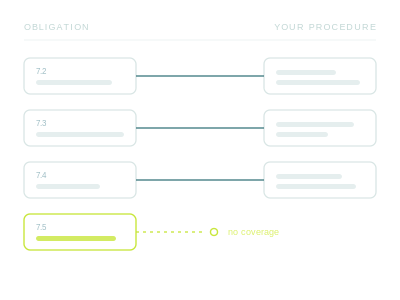
Mapped obligation by obligation, not document by document.
You bring the procedures you already have, in whatever format they are in. GapSure maps them against the regulator’s own text one obligation at a time and scores coverage in five categories: Comprehensive, Adequate, Partial, Insufficient, None. You see which obligations your procedures do not reach.
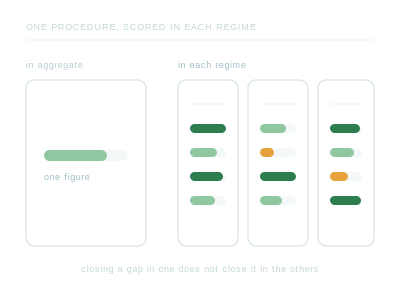
Each regime in its own terms.
You run your procedures against the regulator’s own text in each jurisdiction you answer to and see where they fall short in each regime rather than in aggregate. Closing a gap in one does not assume the others are covered.
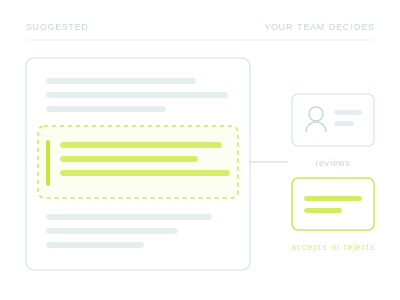
The improvement drafted, your team deciding.
For each gap, GapSure drafts an improvement. Your compliance team accepts or rejects it, then edits the new wording in the document itself, with version control throughout. Nothing enters your procedures without someone in your organisation approving it.
The trail, built as you work.
Every gap, every drafted change, every approval: recorded with the obligation behind it and who signed it off. When someone asks how you know a procedure covers a requirement, that is the answer, assembled as you went rather than reconstructed afterwards.

Start with one domain and one Code
Pick the domain where the burden is heaviest, whether AML/CFT, governance or outsourcing, and one Code to answer against. You upload your procedures, review the gaps, accept the improvements you want to keep, and walk away with the improved procedures and the audit pack.
- ✓ Coverage scored obligation by obligation, Comprehensive to None
- ✓ The gaps named, with the obligation behind each one
- ✓ Drafted improvements your team accepts or rejects, and edits in the document after accepting
- ✓ Improved procedures you keep and own
- ✓ The audit pack for every change
Find gaps. Close them. Prove it.
If you would rather read first, How to Prepare for a Regulatory Inspection is on the site, no form in the way. When you want to see this run against your own procedures, book a demo: thirty minutes, your jurisdiction and your own Code, not a generic walkthrough.