
Fund administrators
GapSure for Fund Administrators
High AML/CFT and governance burden. Frequent regulatory updates. Compliance gaps hidden across policies, teams, and jurisdictions. You use GapSure to find those gaps, draft stronger procedures, and prove defensible coverage with a full audit pack.
If you also run compliance for the funds you administer, that is a different job. See GapSure for client compliance services
The reality today
If you administer funds, these problems are daily.
Your policies were written in good faith, but without verification against current regulation. Compliance gaps accumulate until an audit or examination surfaces them.
Teams chase version history and “who approved what, when.” Evidence exists, but there’s no governed trail connecting regulatory requirements to your procedures.
Different teams interpret the same requirement differently. Some over-control where it’s low value; others leave material gaps where it matters most.
New business lines, products, or jurisdictions trigger repeated compliance exercises that consume weeks, with no certainty the gaps have been closed.
Policies are long, legalistic, and disconnected from frontline operations. Exceptions pile up because the procedures are unclear or incomplete.
AML/CFT updates, outsourcing rules, or conduct requirements change. The response is rework, meetings, and no clear way to prove the gaps have been addressed.
How GapSure changes this
You submit your policies and check them against the regulator’s own text. The gaps come back named, with systems-generated improvements for your team to review and accept.
In one section of a Jersey-based AML regulated firm’s AML Handbook, “Insufficient” compliance items fell from 25.7% to 5.3% after the firm redrafted its own AML policy from GapSure’s output.
Find gaps against the regulator’s own text
You run your procedures through GapSure, one obligation at a time. Coverage scores as Comprehensive, Adequate, Partial, Insufficient, or None, so you know where to focus.
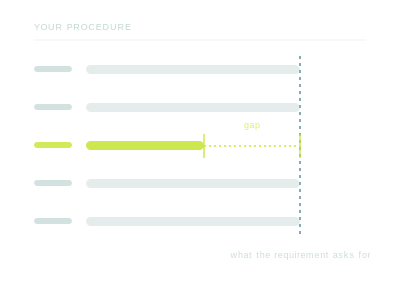
Close gaps with systems-generated improvements
For every gap identified, you get systems-generated procedure improvements. Your policy owner accepts or rejects each one, then edits the new wording in the document itself. Approving the version is a separate permission in GapSure: the approver reads the submitted version and cannot edit it.

Stronger procedures you keep
You get back stronger procedures you keep and own. Your policies are improved, returned, and auditable. In one observed section, average compliance coverage improved from 61.7% to 74.9% on their own bases.

Full audit pack, always
Every gap identified, every improvement drafted, every approval decision: captured in a full audit pack. A regulator asks “how do you know you’re compliant?” You pull it up and show them.

Start with one domain
Pick one: AML/CFT, outsourcing, or conduct. You upload your procedures, review the gaps and improvements, and get back defensible compliance coverage with a full audit pack.
- ✓ Gap analysis against the regulator’s own text
- ✓ Coverage scored: Comprehensive to None
- ✓ Systems-generated procedure improvements
- ✓ Stronger procedures, reviewed & accepted
- ✓ Full audit pack
- ✓ “Insufficient” items: 25.7% → 5.3%
- ✓ “Comprehensive” items: 35.4% → 45.7%
- ✓ Average coverage: 61.7% → 74.9%
- ✓ One section of one firm’s AML Handbook
- ✓ A Jersey-based AML regulated firm
Find gaps. Close them. Prove it.
See how GapSure delivers defensible compliance coverage for fund administrators.